
Your Local Mortgage Lender
Located in Indiana
Personalized Mortgage Experience
Caleb Patton offers personalized service and loan options you'll love. We shop multiple lenders to find the best rate and product for you, getting you into your dream home faster.
With wholesale interest rates and cutting-edge technology, we make the mortgage process seamless. Trust the experts who focus solely on mortgages. Support your local community and experience elite client service.
Let us help you achieve your homeownership dreams!
The Home Loan Process
Mortgage Pre-Approval
Get pre-approved from one of our Loan Officers to see how much you can afford.
House Shopping
Work with a trusted Real Estate Agent to find a home you would like to move into.
Loan Application
Complete your home loan application to get the lending process started.
Don't take my word for it
Mortgage Programs
Experience the best mortgage experience located in Indiana.
Home Loan Options
Our experienced mortgage advisors will walk you through the best mortgage loan program that will fit your specific scenario.
Conventional Home Loans.
FHA Home Loans.
USDA Home Loans.
VA Home Loans.
Frequently Asked Questions
How often can I refinance my mortgage?
There is no limit to the number of times you can refinance. However, you must qualify every time you apply and there will be costs associated with closing the loan each time.
Can I buy a home if I do not have money for a down payment?
Yes! There are a number of bond programs that offer low or no down payment financing options.
How do I know which mortgage is right for me?
The key to choosing the right mortgage is to understand the range of options and features available to you, as well as your budget, circumstances, and goals. Our licensed mortgage professionals are here to help you navigate that process. The more you know, the more comfortable and confident you will be choosing the best option for you and your family.
How long will the loan process take?
The Truth in Lending Act (TILA) does not permit a lender to close a loan until at least seven (7) business days have passed from the date your application was received. A typical home loan takes 30 days, as a number of third-party services such as appraisals, title work, and credit are required in conjunction with the mortgage process. Once you familiarize your Loan Officer with the details of your specific loan scenario, they will be able to provide you with a more specific timeline.
Will I qualify for a home loan?
The only way to find out is to speak with a qualified mortgage professional. Our Loan Officers have helped numerous clients who didn’t know if they could qualify to become home owners. We take the time to understand your financial situation and long-term financial goals, and then match you with the loan program that best fits your needs. Your approval for a loan may also largely depend on the price of the home you are financing. Getting pre-qualified prior to beginning your home search can give you an idea of what you may be able to afford.
Why do people refinance their mortgages?
Homeowners typically refinance to save money, either by obtaining a lower interest rate or by reducing the term of their loan. Refinancing is also a way to convert an adjustable loan to a fixed loan or to consolidate debts.
How much money will I have to pay upfront to buy a home?
This question does not have a simple, one-size-fits-all answer. The exact amount will depend on the price of the home you buy as well the type of mortgage financing you choose. Depending on your loan program, your down payment could be as much as 20% of the home’s price or as little as 3%, while some loans require no down payment at all.
Can I get a mortgage after bankruptcy?
You may still qualify for a home loan even if you have experienced a bankruptcy. The best way to find out if you qualify is to talk with a Loan Officer to discuss your options. Be sure to bring all paperwork regarding your bankruptcy so your Loan Officer can find the program that best fits your situation.
Should I lock my interest rate now, or wait until we are closer to our closing?
Interest rates fluctuate all day, every day. If an interest rate is good, it may be in your best interest to lock now. If you wait, you run the risk of an increase in rates later. If you are concerned that rates may go down after you lock, contact your Loan Officer to discuss your options. Some programs allow you to lock for an extended period and choose to lower your rate should a better one become available.
Most Recent Blog Updates
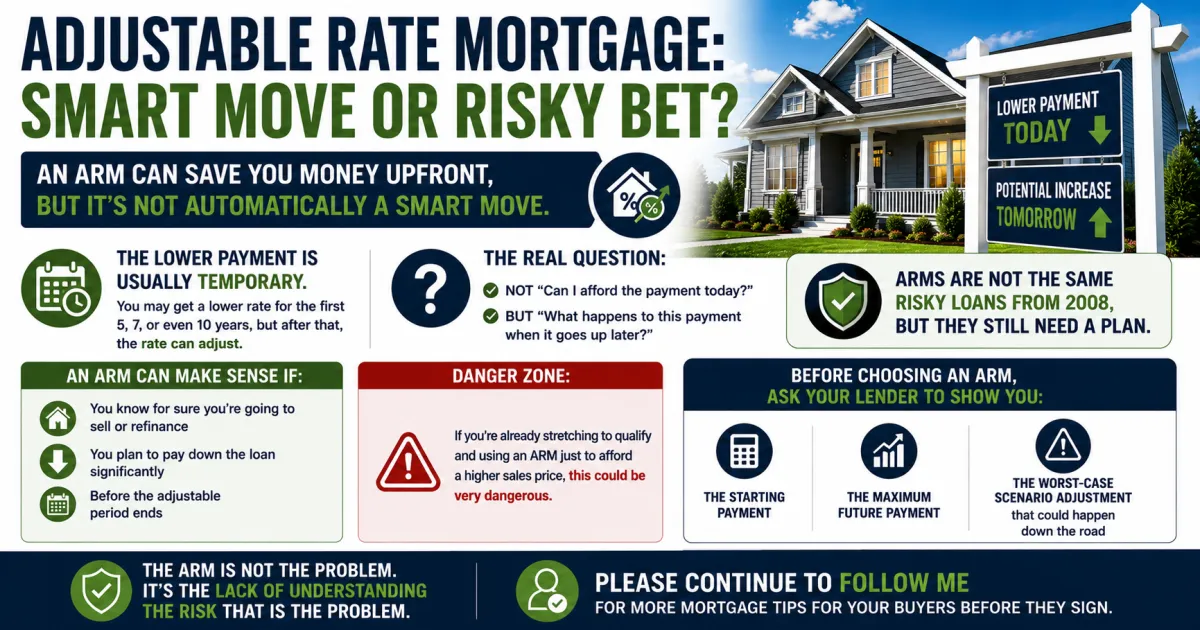
ARM Loans Can Save Money Upfront but Here Is the Risk Most Buyers Never Think to Ask About
The Lower Payment Is Real but the Question That Actually Matters Is Being Skipped
An adjustable rate mortgage can genuinely save you money. The lower initial rate and lower starting payment are real financial benefits that make the ARM attractive when buyers are trying to make monthly costs work in the current rate environment. For the right buyer with the right plan an ARM can be an excellent strategic choice.
But most buyers who are drawn to that lower payment are focused on the wrong question and that mismatch is exactly where ARM decisions go wrong in ways that could have been avoided with a more complete understanding of how the product works.
The Wrong Question and the Right One
Most buyers look at the ARM payment and ask whether they can afford it today. It fits the budget. It qualifies for the home they want. The problem that the fixed-rate payment was creating appears to be solved.
The better question is what happens to this payment when it goes up later.
An adjustable rate mortgage offers a fixed rate for an initial period of five, seven, or ten years. After that period the rate adjusts based on market conditions at the time of each adjustment. If rates have fallen the payment improves. If rates have risen the payment increases and depending on how much the market has moved and what the applicable adjustment caps allow that increase can be meaningful.
A buyer whose budget had no cushion to absorb that increase is in a genuinely difficult position when that first adjustment arrives.
Why Modern ARMs Are Different From 2008 Without Being Risk-Free
The lasting association between adjustable rate mortgages and the housing crisis causes many buyers to dismiss ARMs entirely without understanding how substantially the product has changed. Today's ARM products include caps that limit how much the rate can increase at each individual adjustment and over the life of the loan. Borrowers must qualify under strict lending guidelines. The worst-case scenario is defined and calculable rather than open-ended.
None of that eliminates risk. It means the risk is bounded and can be fully understood before any commitment is made.
When an ARM Makes Sense
As Caleb Patton explains an ARM can be a strategically sound choice when it is paired with a clear and realistic plan for what happens before the adjustment period ends. If you know with reasonable confidence you will sell, refinance, or significantly pay down the loan balance before the fixed period expires you may capture years of lower payments without ever experiencing a rate adjustment.
The key phrase is know for sure. Not hope. Not assume. An actual plan with a defined and realistic path forward.
When an ARM Becomes Dangerous
An ARM becomes genuinely problematic when it is being used to stretch into a home that would otherwise be unaffordable. If a buyer is looking at an ARM primarily because the lower payment makes a higher sales price feel more manageable that is using a financing tool to talk yourself into a decision rather than to optimize a decision you have already made wisely.
If the ARM payment is the only thing that qualifies and there is no realistic path to selling, refinancing, or paying down the loan before the adjustment the lower starting payment is creating false affordability that may not survive the first rate reset.
Three Numbers to Ask Your Lender to Show You
Before committing to any ARM ask your lender to show you three specific numbers. The starting monthly payment under the initial fixed rate. The maximum possible payment under the worst-case adjustment scenario given the applicable caps. And the projected payment after the first adjustment assuming rates stay roughly where they are today.
Those three numbers give you a complete picture of the range of outcomes the ARM could produce. Making the decision with that full picture in view is fundamentally different from making it based only on the attractive starting payment.
The ARM is not the problem. The lack of understanding the risk is the problem.
Caleb Patton works with buyers to evaluate ARM versus fixed-rate options clearly and identify which product actually fits their goals, timeline, and plan. Follow along for more mortgage tips and reach out to Caleb Patton to discuss which loan structure makes the most sense for your specific situation.
Sources
ConsumerFinancialProtectionBureau.gov
FannieMae.com
Investopedia.com
MortgageNewsDaily.com
BankRate.com

Mortgage Calculator
See your total mortgage payments using the tool below.
| Year | Interest | Principal | Balance |
|---|